Stalwart at enterprise scale
Stalwart Enterprise extends the open-source server with the operations features that matter once a business depends on it: multi-tenancy and branding for hosted customers, archiving and un-deletion for fast recovery, real-time telemetry and alerts for your support team, AI-driven spam filtering, masked email for privacy-conscious users, and read replicas and sharded storage for the largest deployments.
Many organisations on the same deployment.
Hosting many customers on shared infrastructure only works if the isolation between them is real. Each Stalwart tenant has its own accounts, groups, mailing lists and domains, with full isolation between them, so a user in one tenant never sees the resources of another. Per-tenant disk quotas and principal-count quotas cap how much of the deployment a single customer can consume, and tenant administrators only see the parts of the system they are responsible for. Each tenant can also bring its own identity backend, so a customer using LDAP or OpenID Connect keeps using it on the shared deployment instead of migrating users.
Tailored branding for a cohesive customer experience.
A hosted customer does not want to see your logo in the admin console; they want to see their own. Stalwart serves a per-tenant and per-domain logo on the web admin and on the customer-facing Account Manager, where end users sign in to manage their own password, application passwords, two-factor authentication and masked email addresses, all under the brand they recognise. White-label hosting becomes a configuration choice, not a fork.
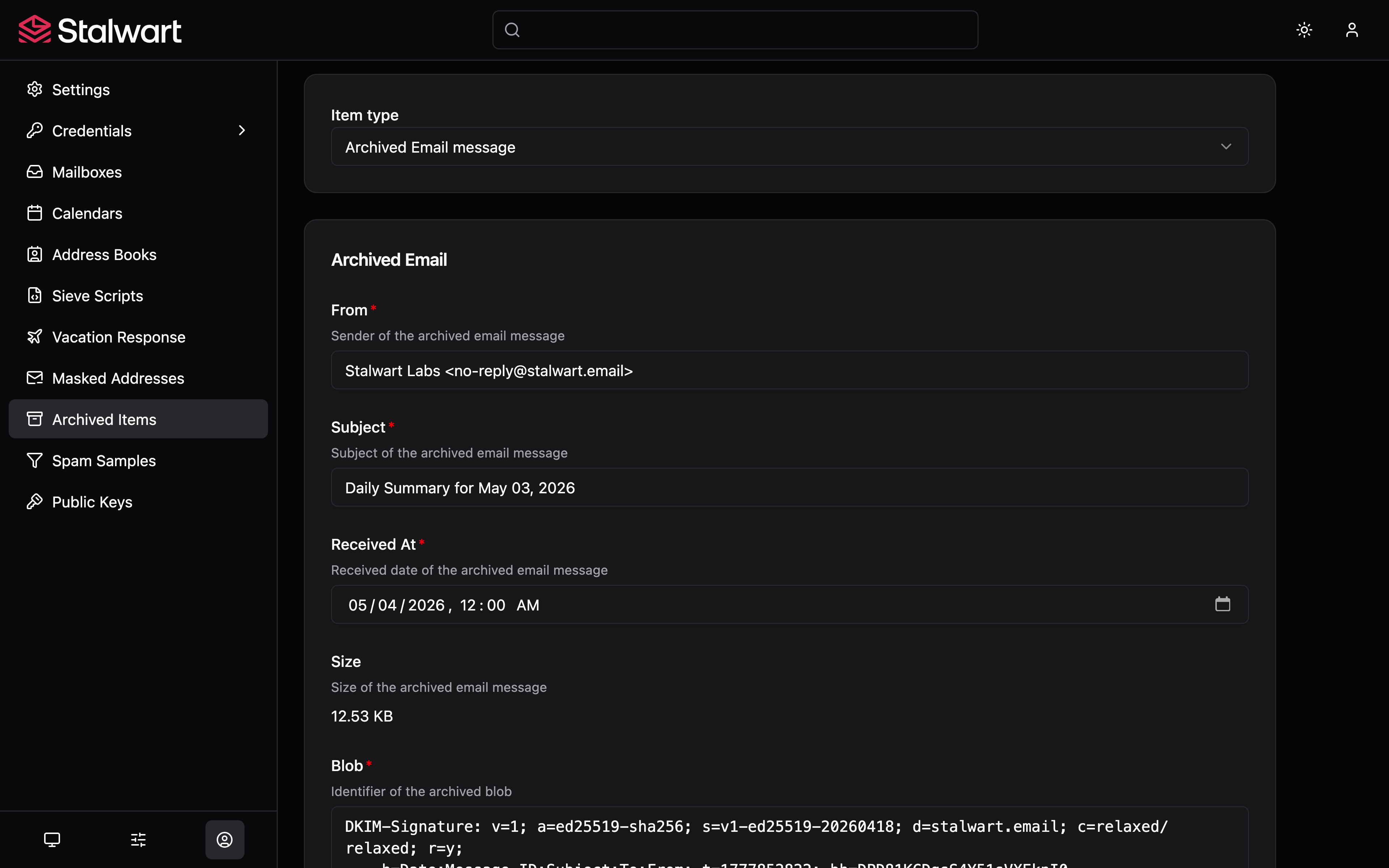
Get deleted mail back, without restoring from backup.
Most "we need to restore from backup" tickets are really about a single deleted mailbox or a handful of deleted messages, not a whole-server failure. Stalwart keeps deleted emails in an archive for a configurable retention window instead of removing them outright. Administrators can browse archived items with their original sender, subject and date, then restore individual messages or whole accounts in a few clicks; the same archive backs full account un-deletion. This shortens the recovery loop after a misconfigured filter rule, an over-eager retention policy or a user mistake. It does not replace backups, but it removes the most common reason operators reach for them.
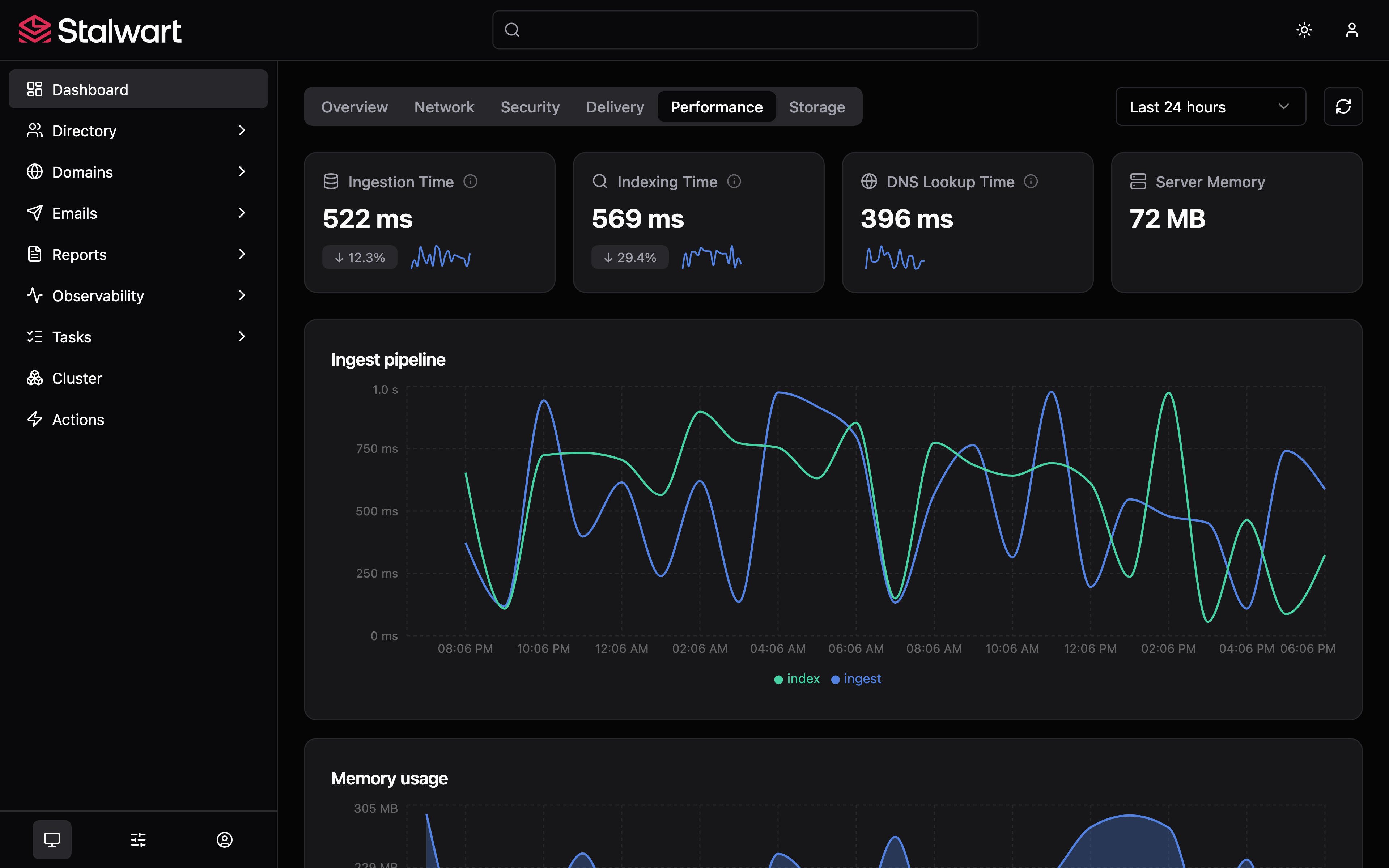
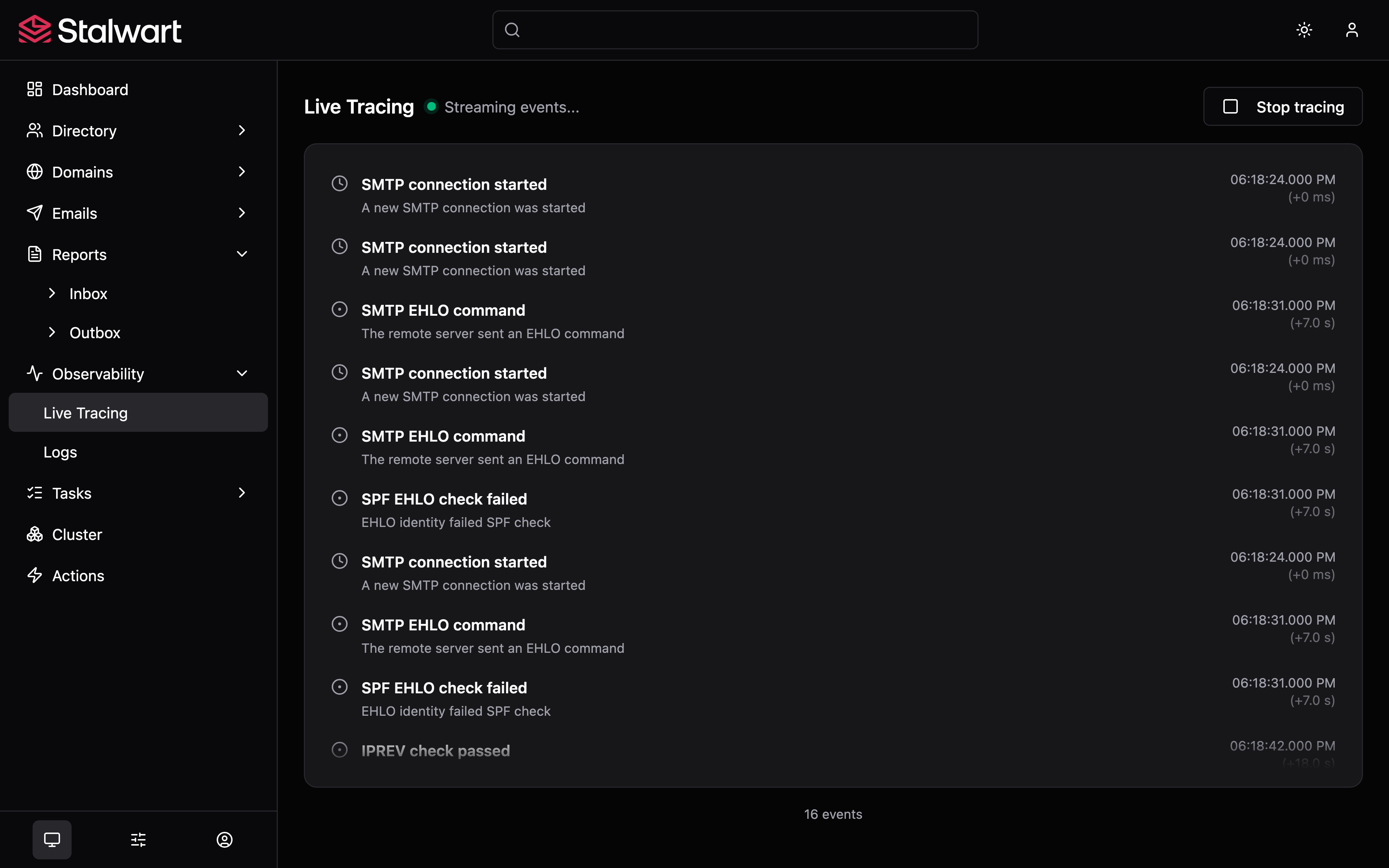
Real-time insights and alerts for complete email oversight.
Enterprise includes a real-time dashboard and live telemetry streams, so support engineers triaging a ticket see what is happening on the server right now, not what happened five minutes ago. Logs, traces and metrics stream in real time and can be filtered by remote IP, domain, account or protocol. Alerts evaluate expressions against the live metric stream and can trigger webhooks, send an email to a list of recipients, or both. Conditions can combine multiple metrics, so a noisy single-metric threshold gives way to alerts that fire on patterns operators actually care about.
AI in the spam filter, not just on the side.
The Enterprise spam classifier can call out to a large language model alongside the statistical classifier, the blocklist pipeline and the rest of the anti-spam stack, so a model gets the chance to read the messages your filter is least sure about. The same AI integration is available to server-side filter rules, so operators can build custom analyses (urgency detection, language detection, automated triage) without leaving the server. Any OpenAI-compatible endpoint is supported, so models can run on a hosted provider (OpenAI, Anthropic) or on infrastructure you already operate, for privacy or cost reasons.
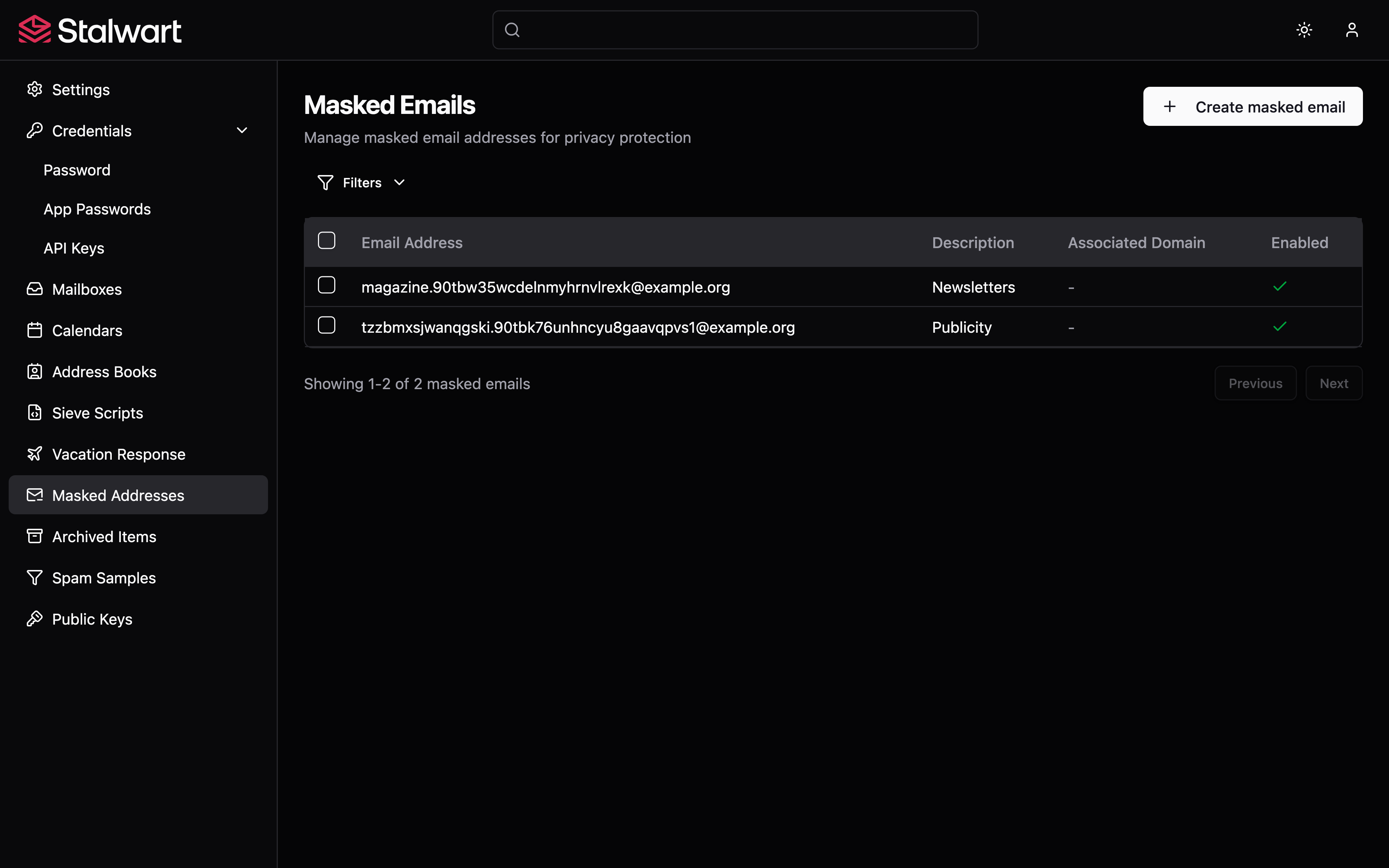
Disposable addresses for users who care about privacy.
Privacy-conscious users want a different email address for every site they sign up to, so a leak at one site does not become spam at the rest. Stalwart lets end users create disposable addresses directly from their Account Manager or through any password manager that supports the standard. Each mask carries a description and an enabled toggle, so a user can disable a leaking address without losing the record of where it was handed out. This gives mailbox operators a privacy primitive to surface to their customers without running a separate aliasing service.
Let your identity provider open and close the mailbox.
A new hire needs a working mailbox on their first morning, not after their first login, and a departing employee's mailbox should stop accepting mail on the day they leave. Stalwart implements the SCIM 2.0 service provider interface, so the identity provider that already owns your directory creates the account when the identity is created, updates it when the person changes name or group, suspends it the moment access is revoked, and deletes it when policy calls for it. It pairs with OpenID Connect: the identity provider owns authentication, SCIM owns the account lifecycle, and no password ever crosses the provisioning interface. Microsoft Entra ID, Okta and Keycloak each have a documented setup procedure, and their default attribute mappings work unmodified. Provisioning is enabled per domain, so older domains can stay on the just-in-time model while new ones move across.
Scale the data plane without rewriting the cluster.
Read traffic outweighs write traffic in a typical mail deployment, and the easiest way to absorb the read side is to add replicas. Stalwart routes read-heavy workloads to secondary copies of the data store while writes continue to target the primary. Sharded blob storage spreads message bodies across multiple backends, so total throughput and capacity grow with each shard added; sharded in-memory data stores do the same for the hot-path key-value layer used by sessions and rate limits.
One deployment, many customers, your brand.
For ISPs, MSPs and white-label hosters, the operational features above combine into a single hosting platform.
- Multi-tenancy isolates customers from each other, with per-tenant disk and principal quotas and per-domain directory backends.
- Branding lets each customer see their own logo at their own domain, on the same WebUI bundle.
- Account Manager gives each customer's end users a self-service portal for passwords, 2FA, application passwords and masked email.
- Live telemetry, alerts and message delivery history give support engineers the data they need to triage tickets.
- Lawful interception is available on demand for jurisdictions that require it.
- Domain-anchored licensing ties the Enterprise key to a domain name and keeps the per-server count unlimited under that domain.
Priority Support, included with Enterprise.
Production deployments need a way to reach the people who build the server, not just a community forum. Premium Support is included at no extra cost with every Enterprise subscription of 150 mailboxes or more. Tickets get an initial response within 48 hours during business hours, and a direct line to the engineers who write Stalwart. A dedicated Support Engineer, a custom SLA with tighter response targets, and lawful-interception assistance are available as separately purchasable add-ons on top of Premium Support, for organisations that need them.